
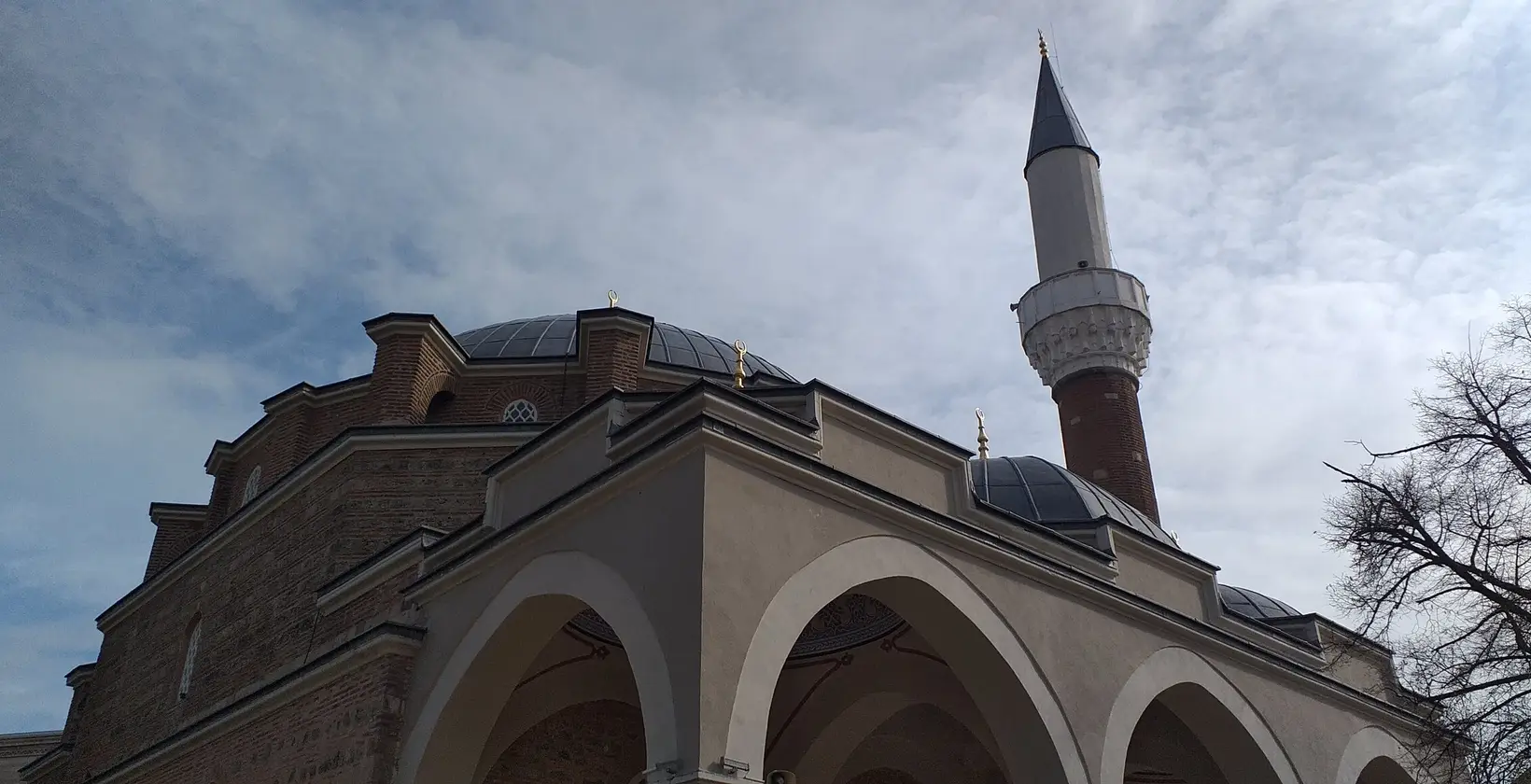
Who built it
Banya Bashi was built by Kadı Seyfullah Efendi, who served for many years as the kadı, or judge, of Sofia and was also known as Molla Efendi.1 This is why some sources call it the Molla Efendi or Kadı Seyfullah mosque.23 Beyond that, all we know about him is that he had a tomb (türbe) beside the mosque, and that it was destroyed after the Russo-Turkish War of 1877–78 together with many other Islamic monuments in the city.2
When Evliya Çelebi described Sofia in the 17th century, he listed the Molla Efendi mosque among the important mosques of the city and wrote that no other minaret in Sofia was as beautiful as its own.12
When it was built
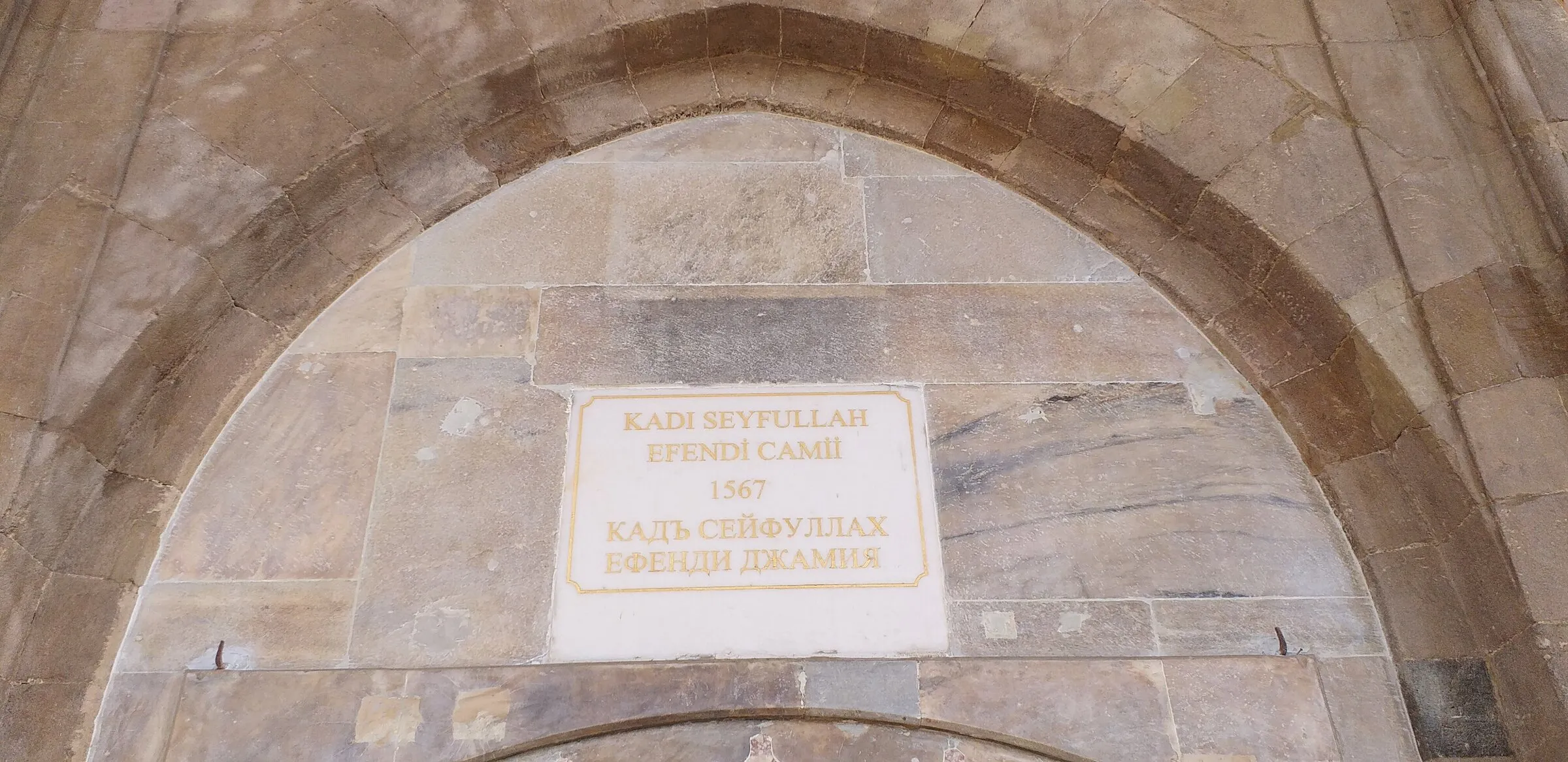
There was once a short inscription painted on the stone of the entrance arch. The words could no longer be read, but beneath them was the date 974 in the Hijri calendar, which corresponds to 1566–67.23
Later a stone plaque in Bulgarian and Turkish was put up in the same place, naming the great Ottoman architect Mimar Sinan as the builder. The architectural historian Ekrem Hakkı Ayverdi noted that there is no solid evidence for this.2 The building in Sofia that is documented as Sinan’s work is a different mosque, the one founded by Sofu Mehmed Pasha. At the end of the 19th century it was turned into the Church of the Seven Saints (Sveti Sedmochislenitsi).1
Where the name comes from
In Turkish banya başı means “by the bath”. There was a bathhouse (hamam) right next to the mosque, and the mosque was named after it.2 The area is known for its hot mineral springs. Evliya Çelebi already mentions a quarter of Sofia called Bana or Ilıca, “the hot spring”,1 and the Central Mineral Baths next door still draw their water from the springs beneath the building.4
The one that survived
On 8 June 1902 the mufti of Sofia, Mehmed Hüsnü Efendi, drew up a register of the city’s mosques. Before the war of 1877–78 Sofia had 41 mosques and 3 smaller ones (mescid), and by the time of his register this was the only one left.2 It had been damaged either in the fighting or in the strong earthquake of 1858, which also brought down the finial (alem) at the top of the minaret. After the war the mosque also lost its endowment (waqf), which consisted of eleven shops, a bakery, an inn and a garden.2
More than once the mosque came close to being pulled down. In 1890 the mayor, Dimitar Petkov, decided to demolish both the mosque and the bathhouse beside it to make room for a new bath. The Ottoman government stepped in and the plan was dropped. In 1906 the municipality again gave permission to demolish the two buildings. This time the old bathhouse did come down and the new mineral baths were built, but the Sublime Porte protested so strongly that the mosque was spared once again.2 The main building of the Central Mineral Baths opened on 13 May 1913.4
Repairs over the years
| Year | Work |
|---|---|
| 1882 | Prince Alexander I granted 15,000 francs for a partial repair.2 |
| 1904 | Sultan Abdülhamid II donated 100 lira.2 |
| 1915–1917 | The Ottoman Ministry of Pious Foundations paid 15,000 lira for a major repair. The minaret was rebuilt in a different shape and made shorter, and the marble minbar, which had cracked in the earthquake, was replaced with a wooden one. In 1917, 36 tonnes of lead were sent to roof the domes.2 |
| 1983 | The National Institute for Cultural Monuments restored the whole exterior to a design by the architect Hristo Ganchev.2 |
| 1990–2007 | Donors paid for new plaster, paintwork and underfloor heating. In 2007 the mihrab and the walls up to the second row of windows were covered with Kütahya tiles, a new minbar and kürsü were put in, and the painted decoration on the walls and the dome was renewed.2 |
| from 2012 | Metro construction under the mosque in 2009 and an earthquake in May 2012 left dangerous cracks in the building. The same year the Turkish Cooperation and Coordination Agency (TİKA) began a full restoration, which included new lead on the domes.2 |
Banya Bashi today
Banya Bashi is the only working mosque in Sofia.51 It was declared a cultural monument of national importance in 1955.6 Visitors are welcome all year round, and you’ll find practical details on the Visit page.
Footnotes
-
İlhan Şahin, “Sofya”, TDV İslâm Ansiklopedisi, vol. 37, pp. 344–348. https://islamansiklopedisi.org.tr/sofya ↩ ↩2 ↩3 ↩4 ↩5
-
Sefer Hasanov, “Kadı Seyfullah Efendi Camii”, TDV İslâm Ansiklopedisi, suppl. vol. 1, pp. 699–701. https://islamansiklopedisi.org.tr/kadi-seyfullah-efendi-camii ↩ ↩2 ↩3 ↩4 ↩5 ↩6 ↩7 ↩8 ↩9 ↩10 ↩11 ↩12 ↩13 ↩14 ↩15
-
Grand Mufti’s Office of Bulgaria, “Първата дама на Австрия посети джамията „Баня баши“” (The First Lady of Austria visited Banya Bashi Mosque). https://www.grandmufti.bg/bg/up-to-date/novini/262-parvata-dama-na-avstriya-poseti-dzhamiyata-banya-bashi.html ↩ ↩2
-
Sofia Regional History Museum, “Central Mineral Baths” (in Bulgarian). https://www.sofiahistorymuseum.bg/bg/obekti/zentralna-mineralna-banj ↩ ↩2
-
Grand Mufti’s Office of Bulgaria, news item on Lyubomir Mikov’s book Mosques in Sofia (21 May 2019). https://www.grandmufti.bg/en/za-nas-3/news/7715-izleze-ot-pechat-knigata-na-lyubomir-mikov-dzhamii-v-sofiya-4.html ↩
-
National Institute for Immovable Cultural Heritage (NIICH), list of immovable cultural assets of national importance in Sofia, entry “Джамия „Баня баши““ (Izvestia no. 73/1955; State Gazette no. 25/1998). http://ninkn.bg/documents/download/60 ↩